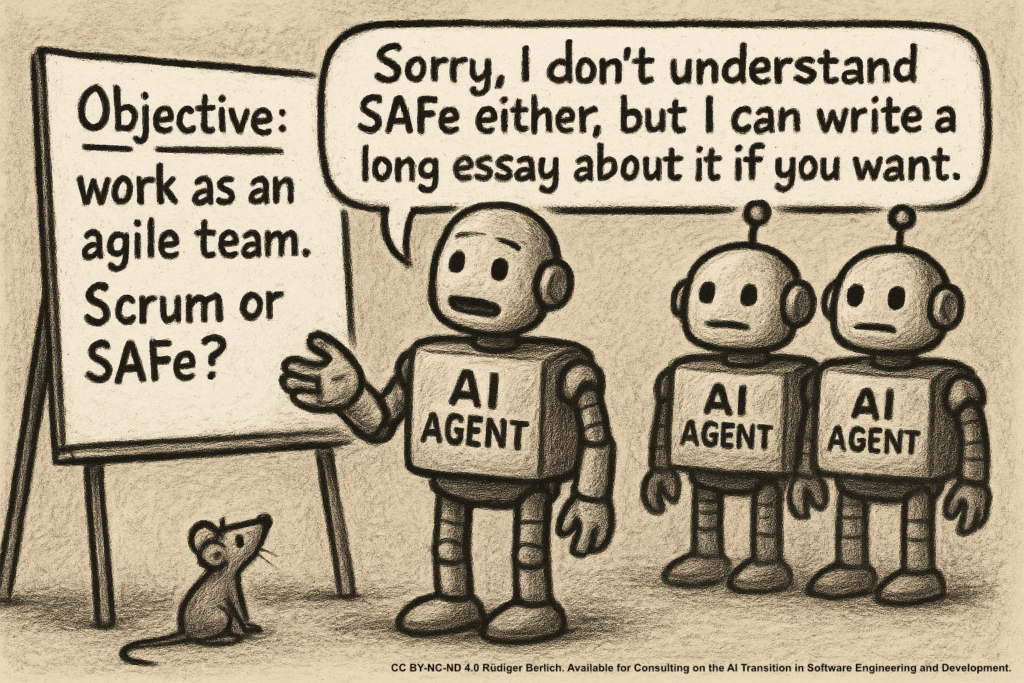
Since around 2015, I have worked exclusively as a consultant for companies adopting agile methodologies. With one exception, all chose the SAFe framework over Scrum. In theory, Scrum is a far simpler concept than SAFe, and few organizations implemented SAFe fully, and even fewer truly understood it.
At the management level, SAFe creates the illusion of control, albeit at the cost of excessive complexity. Scrum, by contrast, introduces the idea of the Product Owner as the “CEO of the product,” a principle I have rarely seen applied in practice. Traditional hierarchies have always persisted. SAFe implicitly acknowledges this by assigning the Product Owner a more limited role.
Scrum also tends to overlook the importance of long-term planning, which SAFe addresses through Program Increment (PI) Planning, typically spanning four to five sprints. I have found these sessions particularly valuable—especially when treated as rolling PIs, updated after each sprint. Long-term planning becomes crucial in companies that develop hardware alongside software, where hardware development cycles are much longer and often less adaptable to agile practices.
At the software developer level, however, the differences between SAFe and Scrum are less pronounced. As so often, the truth lies somewhere in between: in human-centered development environments, pragmatism prevails.
Yet things are changing again. In recent months, we’ve gained the ability to conduct entire agile processes with swarms of AI agents (see, for instance, my article on Claude Flow at Heise). In this emerging environment, I have found that the Scrum approach, enhanced by AI-assisted, up-front PI Planning, delivers the best results.
The evolution from traditional agile methods toward AI-supported collaboration marks a natural next step — one where the balance between structure and adaptability must once again be redefined. In this new context, agile principles remain relevant, but their successful application depends less on frameworks like SAFe or Scrum, and more on our ability to integrate intelligent systems with human judgment.
Have fun,
Rüdiger